

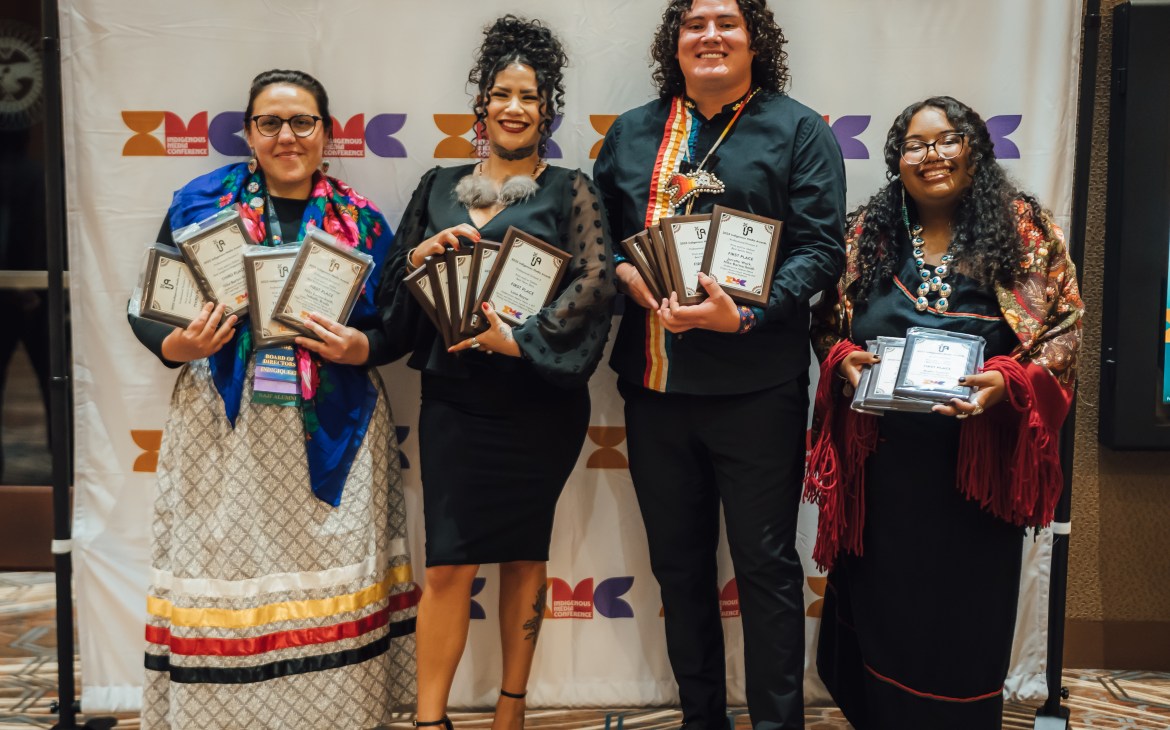
The Indigenous Journalists Association will recognize outstanding coverage through the 2026 Indigenous Media Awards during the Indigenous Media Conference, July 22-24, 2026, at the Portland Marriott Downtown Waterfront in Portland, Oregon.
The deadline for entries is Monday, March 30, 2026, at 11:59 p.m. ET. Anyone needing assistance with awards entries can join IJA’s awards office hours with Director of Membership Sheena Roetman-Wynn anytime from noon to 2 p.m. ET on Fridays in March.
The annual competition recognizes excellence in reporting by Indigenous and non-Indigenous journalists across the U.S., Canada and globally.
2026 Contest Rules and Instructions
Divisions Overview
Please note: Newsroom size is provided as a guideline only. Entrants should select the division that best reflects the size and capacity of their newsroom. “Small” divisions are designed for newsrooms with smaller staff and more limited resources, while “Large” divisions are intended for newsrooms with larger staff and greater organizational capacity.
| Division | Who Can Enter | Indigenous Affiliation Required? | IJA Membership Required? | Newsroom Size | Notes |
| Student Division | Indigenous undergraduate and graduate students | Yes | Yes – must specify Indigenous affiliation | N/A | Non-Indigenous students should enter the appropriate Associate Division based on newsroom size |
| Associate Division – Small Outlets | Non-Indigenous journalists | No | No (membership optional; fee difference applies) | Fewer than ~10 staff | For non-Indigenous entrants working in small newsrooms |
| Associate Division – Large Outlets | Non-Indigenous journalists | No | No (membership optional; fee difference applies) | More than ~10 staff | For non-Indigenous entrants working in large newsrooms |
| Professional Division – Small Outlets | Indigenous journalists | Yes | Yes – must specify Indigenous affiliation | Fewer than ~10 staff | Indigenous entrants only |
| Professional Division – Large Outlets | Indigenous journalists | Yes | Yes – must specify Indigenous affiliation | More than ~10 staff | Indigenous entrants only |
Important Membership Notes
- MEMBERSHIP POLICY: As of 2024, entrants in the Student and Professional divisions must have a current IJA membership that specifies Indigenous affiliation.
- ASSOCIATE NON-MEMBERS: Associate Division entrants do not need a current IJA membership, but entry fees differ for members vs. non-members.
- Associate members and non-Indigenous students may only enter the following categories:
- PRINT / ONLINE: Best Coverage of Indigenous Communities.
- RADIO: Best News Spot: A news story, ~1 minute in length, that touches on a hard news story dealing with health, education, politics, economic development, race relations, policy, etc.
- RADIO: Best Feature Story: A narrative, sound-rich story that is news-based or human-interest oriented, covering arts, community events or unique profiles of individuals or groups. Single entries may be approx. three to 10 minutes long.
- TV: Best News Story: A story from ~1-8 minutes in length that touches on a hard news story dealing with health, education, politics, economic development, race relations, or policy.
- TV: Best Feature Story: Entries must be less than 10 minutes in length.
- PHOTO: Best Photo of Indigenous Communities.
- Associate members and non-Indigenous students may only enter the following categories:
- MULTIPLE BYLINES: Entries with multiple bylines or credits from a team with at least 50 percent Indigenous entrants may enter the Professional (Indigenous) Division. Teams with less than 50 percent Indigenous entrants listed should enter the Associate Division.
IMA Category Descriptions
Categories that allow or require more than one piece are specified in the category description. All other categories are limited to a single piece.
Print / Online
Individual Categories
- Best Longform / Magazine Story: For in-depth pieces with a high word count (2500) that take a deep dive into an Indigenous issue.
- Best Editorial / Column
- Best Elder Coverage/AARP Elder Coverage Award
- Best Health Coverage: Entries must include at least two stories.
- Best Environmental Coverage: Entries must include at least two stories.
- Best Sports Coverage: Entries must include at least two stories.
Outlet-Based Categories
- General Excellence: Recognizing excellence in print media, including tribal media publishing digitally. For Indigenous-owned media outlets that are at least 50 percent Indigenous-owned, managed or controlled.
- Entrants must submit links to three or more printed editions to be considered for this category. Include links to at least three issues and no more than five.
- Best Layout: Recognizing outstanding page design and layout for print publications. For Indigenous-owned media outlets (tribal media) that are at least 50 percent Indigenous-owned, managed or controlled.
- Entrants must submit links to three or more editions to be considered for this category.
Radio/Podcast
Individual Categories
- Best News Spot: A news story, ~1 minute in length, that touches on a hard news story dealing with health, education, politics, economic development, race relations, policy, etc. Open to Associate entrants.
- Best Feature Story: A story that is human-interest oriented, covering arts, community events or unique profiles of individuals or groups. Single entries may be ~3 to 10 minutes in length. Open to Associate entrants. For Indigenous student and professional members, entries longer than 10 minutes may enter the Best Multimedia category.
- Excellence in Beat Reporting: Include links to at least three broadcasts and no more than five.
Outlet-Based Categories
- General Excellence: For Indigenous-owned media outlets (tribal media) that are at least 50 percent Indigenous-owned, managed or controlled. Include links to at least three broadcasts / episodes / newscasts (2-20 minutes) and no more than five.
TV
Individual Categories
- Best News spot: A story from 1-5 minutes long that touches on a hard news story dealing with health, education, politics, economic development, race relations, or policy. Open to Associate entrants.
- Best Feature Story: Entries must be less than 10 minutes; Any entries over the allotted time may enter the Best Multimedia category. Open to Associate entrants.
Outlet-Based Categories
- General Excellence: For Indigenous-owned media outlets (tribal media) that are at least 50 percent Indigenous-owned, managed or controlled. Include links to at least three issues / clips / newscasts (2-20 minutes) and no more than five.
Best Multimedia
- Category open to podcasts, documentaries, series or extended interviews/talk shows, compilations of audio, video, images and original art for online audiences. Can be stand-alone or complementary to published content. Entries may be one minute up to an hour in length.
Photo
- Best News Photo
- Best Feature Photo
- Best Sports Photo
Special Coverage
Entries may be of any length and may be a single story or a series in any format, including print, digital, TV, radio, podcast, etc.
- Best Two-Spirit Coverage: Open to coverage of Two-Spirit / Indigenous LGBTQ+ issues and people.
- Best International Indigenous Coverage: Open to reporting on Indigenous communities outside the United States and Canada.
IMA Special Awards
2026 IJA-Medill Milestone Achievement Award
The IJA-Medill Milestone Achievement Award recognizes important contributions by journalists in the past and encourages the new generation of Indigenous journalists to achieve career excellence. This award honors IJA’s mission and the exemplary people who have led the way with outstanding work and contributions to the field of journalism.
The winner of the IJA-Medill Milestone Achievement Award will receive $5,000 from the Medill School of Journalism at Northwestern University. IJA will present the award during the 2026 Indigenous Media Conference. All entrants must be IJA members; however, there is no entry fee and there is no cost to nominate a member for this award.
2026 IJA Elias Boudinot Free Press Award
The IJA Elias Boudinot Free Press Award recognizes a publication or media outlet that has shown dedication and commitment to upholding freedom of the press, information and transparency within Indigenous communities. Entrants/nominees must be current IJA members; however, there is no entry fee for this category, and there is no cost to nominate a member for this award. The recipient will be honored during the 2026 Indigenous Media Awards Banquet.
2026 IJA Richard LaCourse Award for Investigative Journalism
The IJA Richard LaCourse Award for Investigative Journalism honors groundbreaking work by an Indigenous journalist or a team that creatively uses digital tools as a community watchdog. Special consideration is given to journalism that helps a community understand and address important issues. The award includes a cash prize for the selected recipient. Entrants/nominees must be current IJA members; however, there is no entry fee for this category, and there is no cost to nominate a member for this award. The recipient will be honored during the 2025 Indigenous Media Awards Banquet.
2026 IJA Tim Giago Free Press Award
As one of the founders of the Native American Press Association in 1983, Tim Giago shaped the mission of what is now IJA. This mission has always focused on uniting and empowering Indigenous media and championing accurate journalism, despite the unique challenges that come with reporting on our own tribal communities.
The IJA Tim Giago Free Press Award recognizes an individual IJA member who has shown dedication and commitment to upholding freedom of the press, information and transparency within their Indigenous community. Entrants/nominees must be current IJA members; however, there is no entry fee for this category, and there is no cost to nominate a member for this award.The award comes with a cash prize for the selected recipient, who will be honored during the 2026 Indigenous Media Awards Banquet.
2026 IJA Minnie Two Shoes Award for Excellence in Tribal Media
The Minnie Two Shoes Award celebrates the hard work of tribal media professionals who keep our communities engaged, informed and connected. It recognizes a journalist who has shown tenacity in pursuing stories that matter to the people they serve. Tribal media is defined as a local newspaper, radio or TV station, digital outlet that focuses primarily on one tribal community.
Entrants/nominees must be current IJA members and tribal media employees; however, there is no entry fee for this category, and there is no cost to nominate a member for this award.
Contest Rules and Eligibility Guidelines
- Entries will be accepted through the deadline of Monday, March 30, 2026, at 11:59 p.m. ET.
- Entries must have been published between Jan. 1 and Dec. 31, 2025.
- Entrants in all Professional and Student Divisions must have a current IJA membership that specifies their Indigenous affiliation.
- Indigenous affiliation is required for High School, College, Professional and Tribal Media memberships and may also be included for individuals with Lifetime, Corporate, Nonprofit and Sustaining Institutional memberships.
- If an editor or producer is entering work on behalf of an Indigenous colleague at the member rate, the entrant must be a current IJA member or the entry will not be considered.
- Please provide clear directions for locating the entry within any master publication / folder(s). Include page numbers for print/digital and time stamps for broadcast in the Notes section, as needed.
- Entrants submitting a single story from a publication should include relevant issue information, including but not limited to: page number(s), jumps and headline / cutline in the Notes section of the entry form to provide specific location instructions to judges.
- Individuals may submit up to five separate entries in any one category, as desired. Entries in multiple categories are encouraged. (Example: In the best photo category, an individual may submit up to but no more than five different photos to compete against each other. In addition to competing with themselves, entrants would also be competing against other outlets or individual submissions.)
- Contest administrators and judges may combine or transfer entries across categories based on their interpretation of the contest guidelines, or if a category contains fewer entries than the minimum required for judging. Entrants will not be notified of such changes prior to the announcement of awards.
- Judges reserve the right to withhold awards in any category if they determine that no entries merit recognition.
- Current IJA staff and members of the board of directors are not eligible to enter the contest. Submissions edited by board members or produced by outlets employing board members are still eligible as long as board members’ names are not on the submission.
FYI & FAQs using the BetterBNC platform
IMPORTANT: Entrants are encouraged to thoroughly read the instructions below before utilizing the BetterBNC contest entry platform to submit entries. IMA entries may only be submitted via the BetterBNC portal; no email submissions will be accepted. Failure to comply with contest rules may lead to delayed results or disqualification of entries without a refund.
To submit a technical support request anytime throughout the awards process, click the “Help & Support” link at the top left of the main BetterBNC webpage. Then select the “Start Trouble Ticket” at the top of the next page. Entrants and judges may also contact BetterBNC technical support by phone at 360-427-6300 Monday through Friday from 8 a.m. – 5 p.m. PT.
BNC is optimized for the Google Chrome browser; and Firefox for PC and Mac. Please have a recent version installed for the best contest experience.
What is the difference between Registered ‘Authorized Entrants’ vs. Open Call?
- Open Call accounts are recommended for outlets that have entries in both the Associate and Professional Divisions, to accommodate outlets or publications with multiple entries under a single account.
- Open Call entrants may submit under the Professional (Indigenous members) and Associate (non-Indigenous members or non-members) Divisions.
- A separate account is required for Student entries.
- Open Call is the easiest account type to launch for all submissions, including the Student Division.
- Entrants submitting under multiple divisions should follow the instructions for Open Call entries. Preset accounts may be set up by contacting Sheena Roetman-Wynn at sheena@indigenousjournalists.org.
- Registered Authorized Entrants are accounts previously established by the contest administrator. Authorized entrants can only submit to one of the following divisions: Professional (Indigenous), Associate (non-Indigenous) or Student.
How do I create an Open Call Login?
Open Call Login:
- Click “Open Call Login” in the blue bar at the top of the page.
- If you already have an Open Call Contestant account, enter your email address associated with the account and password, then click “Login” and skip to “Request to make entries in a contest” below.
- If you do not already have an Open Call Contestant account, click “Create your Open Call account.”
- Fill out the form.
- Click “Submit” at the bottom of the page.
Once you fill out the form to create your Open Call Contestant account, the system will send you a validation email with a link that must be clicked before you can log in to your account. The contest admin must approve new account requests before entrants can submit entries, and there may be a brief waiting period before new accounts can be approved. Please email Sheena Roetman-Wynn at sheena@indigenousjournalists.org with any questions or concerns.
Request to make entries in a contest (Open Call Only)
- Hover over the red “Open Call Contestant” text in the blue bar at the top of the page
- Select “My Contests” in the menu that appears
- In the “Available Contests” section, check the box next to the contest you would like to enter
- Hover over the red “Open Call Contestant” text again
- Select “Manage Entries”
How do I log in to BetterBNC as an Authorized Entrant?
- Select the contest you would like to enter
- Select your Media Organization
- Enter your email address
- Enter your password
- Click “Login”
Fees & Payment
- Professional and Associate Division fees are $25 per entry for members.
- Student Division fees are $10 per entry for Indigenous student members.
- Non-member fees are $50 per entry (Associate Division only).
- Payment will be accepted via credit or debit cards within the BNC platform, which will be charged via PayPal as a third-party processor. A PayPal account is not required to submit payment.
- All payments must be received by IJA on or before the entry deadline in order to be eligible for judging.
- Payment via purchase order, invoice or check by mail will only be accepted for Indigenous media outlets. Checks should be addressed to: NAJA – OU Gaylord College, 395 W. Lindsey St., Norman, OK 73019.
- If entrants encounter issues with the BNC payment interface, they should check that the billing address and card information are correct before submitting a help ticket.
- On the “Calculate Entry Fee” page, select the paid entries, then click the “Pay Now with Card” button.
- Look in the upper-right corner of the address bar for a small icon with a red “X” over it. Click the icon, and an option to allow BetterBNC to forward to PayPal should appear.
- Entrants may need to refresh the page, re-select the entries, then click “Pay Now with Card” again to be taken to the payment form to enter a card number and billing address.
- IJA may not issue refunds, but will make every attempt to judge all entries submitted, which may result in categories or divisions being combined to meet the minimum entry requirement.
BNC Payment info (see bullet list above for troubleshooting if it doesn’t ask for billing address)
- When all entries are submitted, log in to your account
- Navigate to the Manage Entries page
- Click “Calculate Entry Fees”
- Follow the on-screen instructions to pay for selected entries